What MCP Standardizes, and What It Leaves to You
The Model Context Protocol made tools plug-and-play. It did not make them safe, paid for, or reliable. Those parts are still yours — and important enough to deserve a lot of your attention.

You have a tool — an API, a database, a workflow — and you want an AI agent to be able to use it. The Model Context Protocol is the standard that lets you expose it: the agent discovers what your tool can do and calls it, and that part is now plug-and-play. What MCP did not do is make your tool safe to call, paid for, or reliable. Those parts were never in the protocol, and they are still yours to build.
That is not a gap in the standard. It is the point of it — and it is where all the interesting work in agent infrastructure has moved.
The two things MCP actually standardizes
The Model Context Protocol is an open standard for plugging tools and data into an AI app. Underneath, it standardizes two things, and only two.
Discovery. Your tool advertises what it can do — its tools, resources and prompts — and a client lists them so the model can decide what to use. Before MCP, every assistant had its own plugin format. Now one description works across clients.
Calling. Messages travel as JSON-RPC 2.0, over stdio for a local process or over HTTP for a remote service. The model asks to call a tool, the client forwards it, your tool answers.
That is a genuinely useful contract, and it is a thin one. The page on MCP and A2A in the AI Builders Wiki covers the mechanics; the point here is what the contract does not do.
What it leaves to you
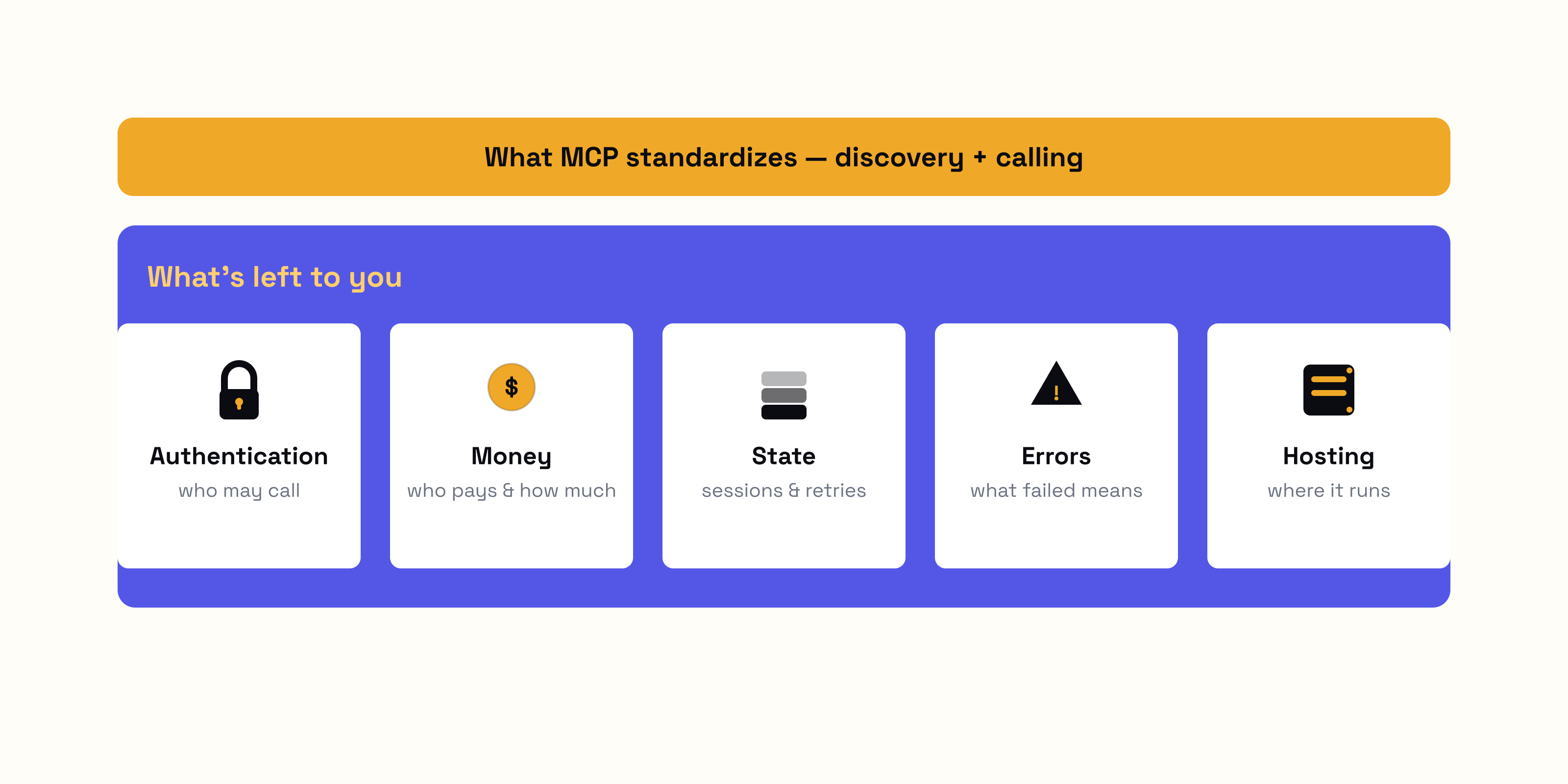
Everything that makes a tool real in production sits outside the wire format.
Authentication and authorization. The protocol does not say who may call your tool, with whose credentials. A tool that can "search tickets" and a tool that can "delete tickets" have the same shape on the wire; the difference is policy. The page on Security in the AI Builders Wiki walks through the questions MCP leaves open.
Money. Nothing in the spec meters a call or caps spending. A tool that calls a paid API on someone's behalf needs its own answer to "who pays, and how much can they spend." The protocol will not stop a runaway loop.
State. MCP messages are largely stateless. Sessions, retries, idempotency, what happens when a call is interrupted halfway through — all of that is yours to build.
Errors. JSON-RPC has an error field, but being told "the tool failed" does not automatically leave the caller with an idea of what to do next. Whether to retry, how to surface a partial result, how to tell the model to try a different approach — none of that is specified.
Hosting. stdio works while your tool runs on the same machine as the client. The moment it should be shared, it becomes a real service with uptime, a public endpoint, and a bill.
Where the product actually is
Here is the shift worth sitting with: the standard made the boring part free, so the valuable part is all that is left to differentiate on .
Ten years ago, "we built a tool" meant building the whole stack — the transport, the schema, the auth, the billing. Today the transport and schema are given to you. What remains — trust, money, reliability — is precisely where you can still win, and it is also where everyone is now competing.
That inverts the usual advice. You do not differentiate by building a cleverer tool-calling layer; that is a commodity now. You differentiate by deciding, concretely, who may call your tool, with whose money, and what happens when it goes wrong.
Keep the adapter thin
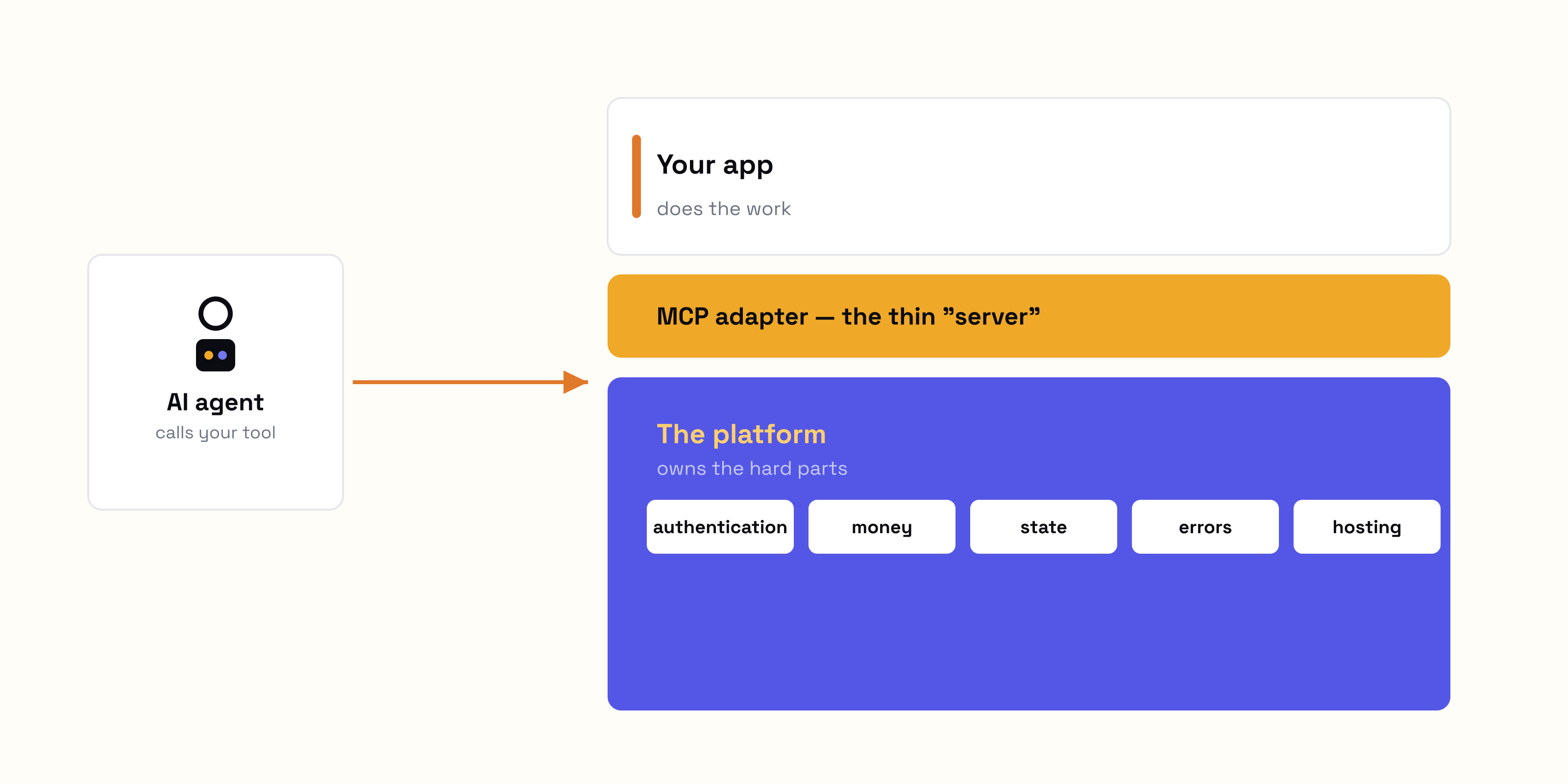
An "MCP server" is just the thin layer that lets an agent reach your app. It is not the app — the app is the thing that does the work. The adapter's only job is to translate between the standard and your app, and its only virtue is staying thin.
The moment that adapter starts carrying authentication, billing, state or retry logic, it stops being an adapter and becomes infrastructure — and that is where most MCP projects get complicated and brittle. There is an easier way: let the platform underneath carry the hard parts, and the adapter can stay thin. You are left with a small, simple layer instead of a small infrastructure project.
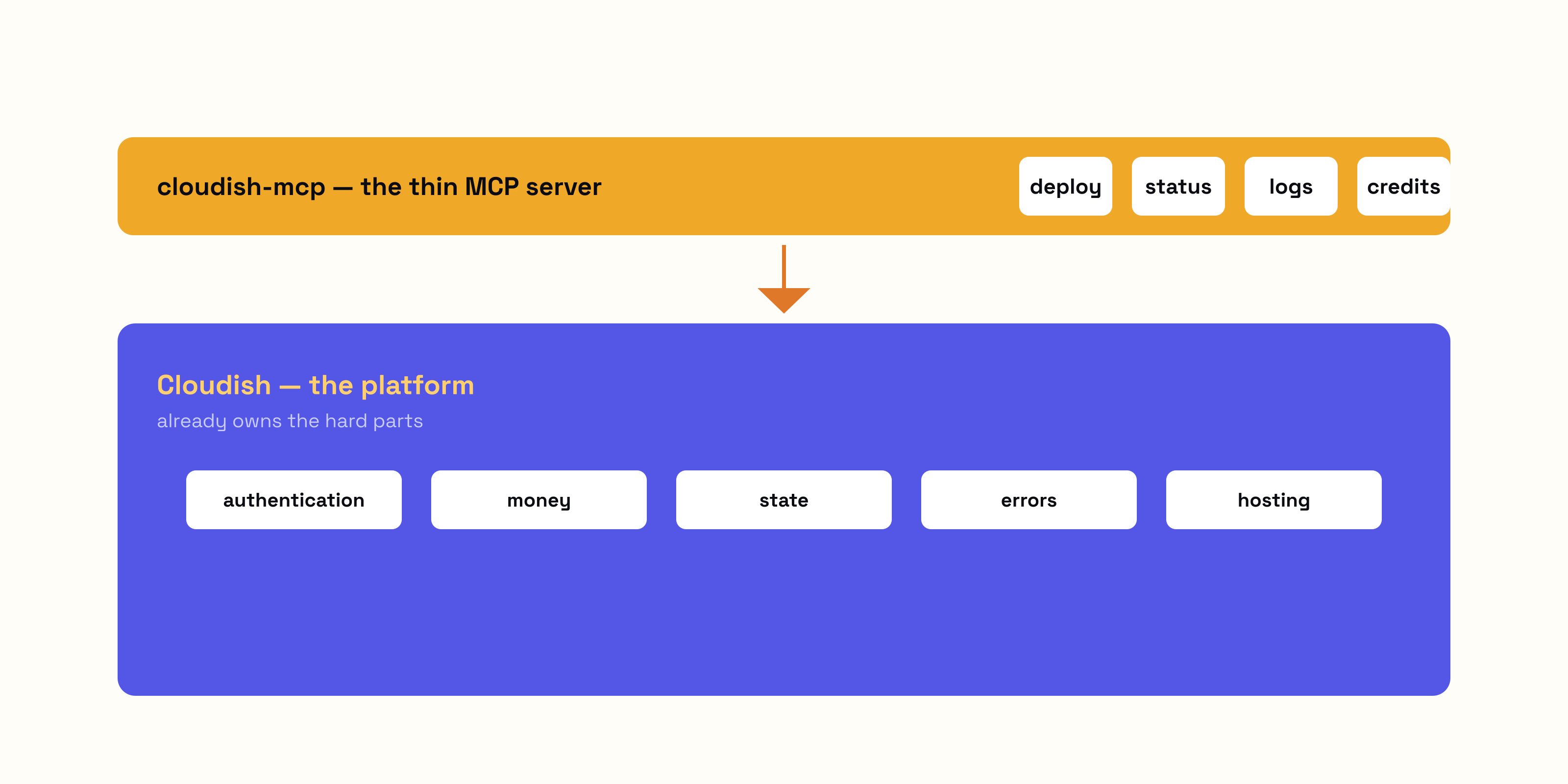
Cloudish already owns the hard parts
That is what Cloudish is. When your app runs on Cloudish, the hard parts already exist:
- Authentication is a key the agent creates with one call — no signup.
- Money is prepaid credits with a hard ceiling, so a runaway loop cannot burn more than is loaded.
- State is a build and a project the agent can poll.
- Errors are a status and logs the agent can read.
The platform owns all of it, so the MCP layer in front of your app can stay a thin wrapper. That is
cloudish-mcp
, the thin MCP server that fronts Cloudish: four tools — deploy, status, logs and credits — and nothing
else. It is thin because it can afford to be — the platform already does the heavy lifting, and the
adapter just exposes it.
The leftovers are the roadmap
If you are exposing a tool to AI, spend your time on the leftovers, not the wire. Decide who can call what. Decide how a call is paid for and capped. Decide what "failed" means and what the client should do next. Decide where it lives and who keeps it up.
There are two ways to handle those leftovers. One is to build them yourself: stand up authentication, metering, retries and hosting around your tool, and run it as your own service. That is building a product — a real one, and a lot of work.
The other is to hand them to a platform. Put your tool on Cloudish, where authentication, money, state and errors already exist, and your MCP layer stays a thin wrapper. That is keeping a thin adapter — and skipping the infrastructure project.
The wire was never the hard part — it was just the part everyone could agree on. What remains is the job: the decisions MCP will never make for you. Build them yourself, or hand them to Cloudish. Either way, MCP did not build it for you.
Sources
All links checked 26 November 2026.
- MCP and A2A — aibuilderswiki.com — what each protocol connects, and how they differ.
- Security for AI apps — aibuilderswiki.com — the questions MCP leaves open around who may call which tool.
- Model Context Protocol — specification — tools, resources, prompts, JSON-RPC 2.0.
- MCP joins the Agentic AI Foundation — governance under the Linux Foundation.